


































Best Tasting Protein Bars: What Actually Fixes a Chalky Bar
Most bars that taste bad taste bad for the same reason. There are two ways to fix it.
Most bars that taste bad taste bad for the same reason. There are two ways to fix it.
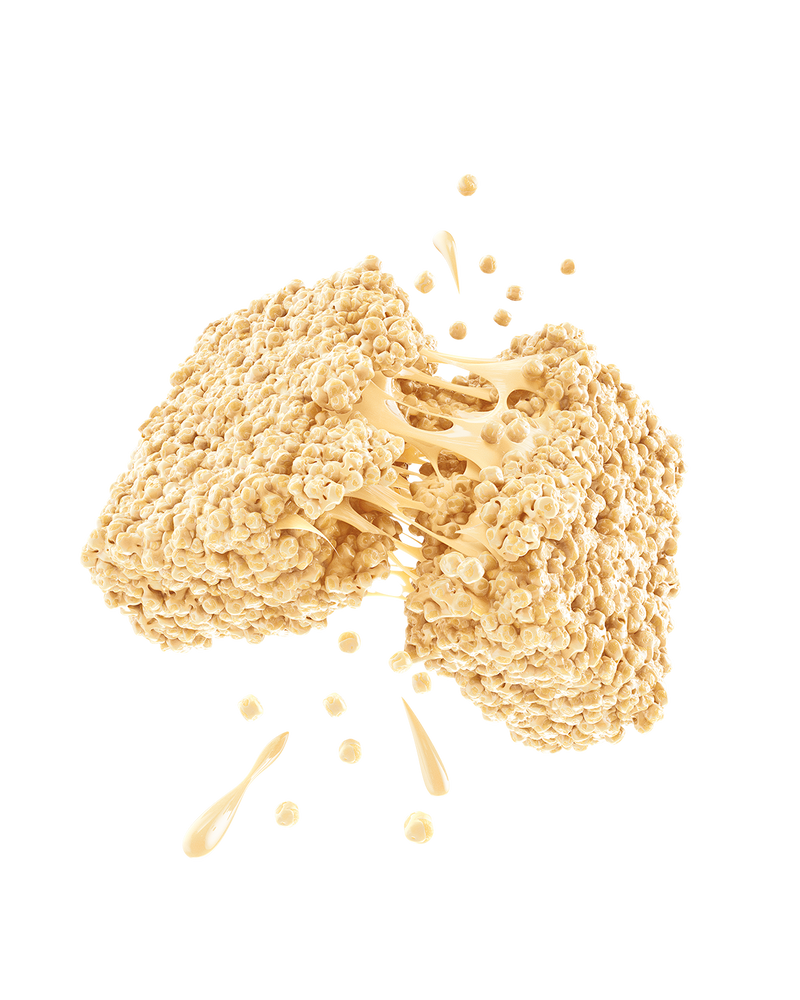
Most protein bars that taste bad taste bad because of texture, not flavor. The usual cause is a lot of isolated protein bound with very little fat or moisture, which sets up dry and pasty in the mouth. There are two ways to fix that. Add fat and moisture, which is the route almost everyone writes about. Or change the physical form of the protein before you bind it, which is the route almost nobody writes about.
Puff the protein into a light, thin-walled structure and the bar gets its mouthfeel from air and fracture instead of from fat.[1] Promix Protein Puff Bars are built the second way. Every bar in the 40g line carries 3.0g to 4.5g of total fat, and the first ingredient on the panel is a puff rather than a powder.[5]
Texture words are not interchangeable. Crispy, chewy, soft and chalky are each produced by a different thing, and section 04 sets out which is which.
Promix makes the bar this page uses as its worked example, so we have an interest in how this comes out. The study that is least convenient for a whey-based bar is in section 02, drawn to scale, rather than left out.
Most of the time it is texture, not flavor.
People say a bar tastes like chalk, cardboard or sawdust. What they are describing is how it behaves in the mouth rather than how it is flavored, and that matters because the two problems have different fixes. A flavor problem is solved in the flavor house. A texture problem is solved in the formulation, and no amount of vanilla covers it.
The vocabulary people reach for is consistent. Dry. Chalky. Pasty. Sandy. Food scientists use sandiness as a sensory descriptor, and it is the closest technical term to what buyers mean by chalky.[3]
The same complaint shows up on the powder side of the category, for related reasons. We covered that separately in why protein powder makes you bloated.
Two things, and they compound. The protein bonds to itself, and the water leaves.
Both were measured directly in a 2025 study that tracked whey, pea and rice protein bars through 42 days of storage. Free sulfhydryl content fell 44 percent in the whey bars and 57 percent in the pea bars, which is a marker of proteins bonding to each other. Carbonyl content rose 120 to 390 percent. Sugar-modified protein, the Maillard reaction, rose 7.7 percent in whey.[2]
At the same time the bars dried out, and the two problems feed each other. Water is what keeps the proteins soft and the bar chewy, so as it leaves, the cross-linking gets worse.[4]
Moisture lost from the bar, as a share of what it started with.
Measured in a 2025 laboratory study of model bars, not of commercial products. Promix's bar is whey based, and this is the finding that is least convenient for it.[2]
There is a common answer to this that is half right. It says bars go chalky because they lean on isolated protein powders without enough fat or moisture to carry mouthfeel, and that the fix is whole-food fats like nut butters and oils. That describes the drying half accurately.
What it misses is that moisture is not the only lever. In a 2026 trial, formulators varied glycerol and added water across four builds of one base recipe and measured the sensory result. Sandiness did not move. It tracked the base recipe instead. In the same trial, raising glycerol from 3 to 3.5 percent increased firmness rather than softening the bar, and the consumer panel preferred the firmer samples.[3]
So the honest version is narrower than the popular one. Adding fat and moisture is one real route. It is not the only one, and on its own it does not remove sandiness.
Five lines, one panel
Nutrition Facts and Key Ingredients are on the product page.
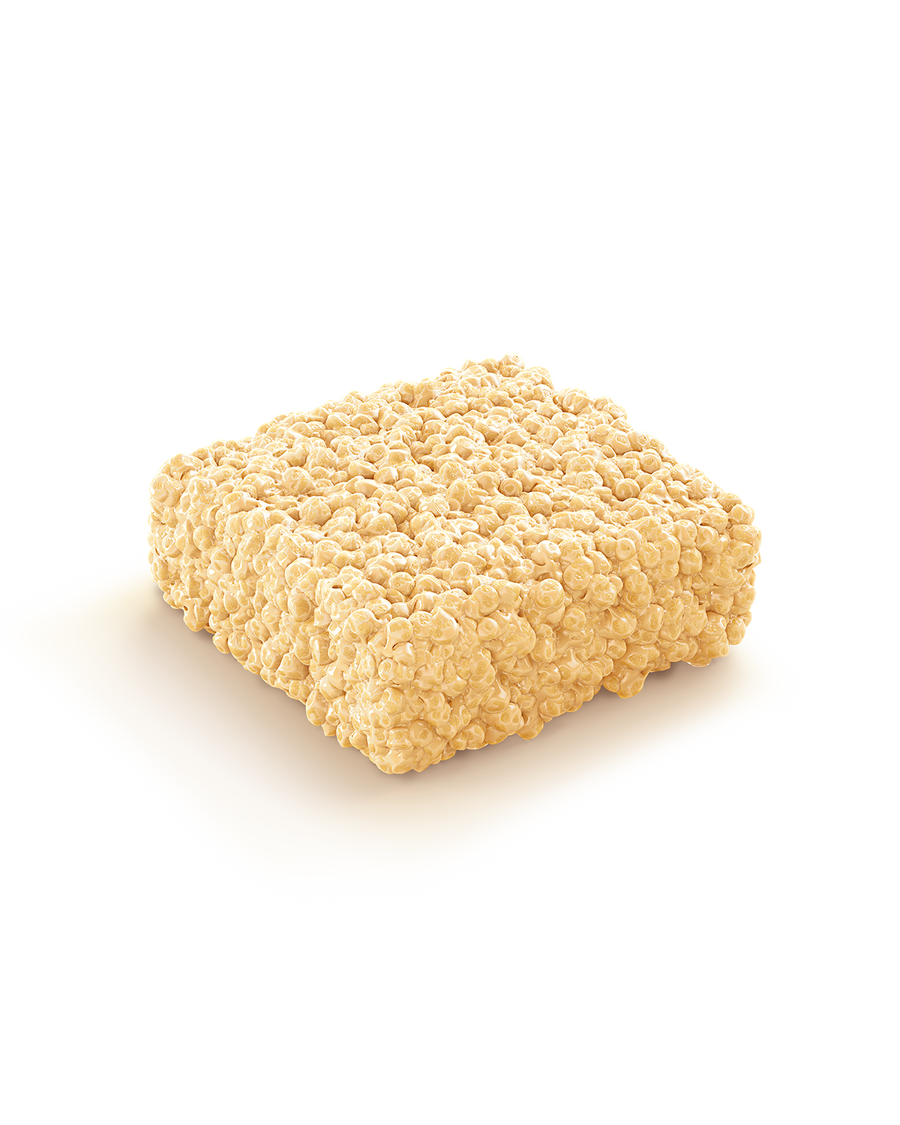
Change the shape of the protein before you bind it, and the bar does not need much fat at all.
Read the Promix Vanilla Protein Puff Bar panel in the order it is written, because the order is the argument.
PROMIX Whey Protein Puffs (whey protein isolate, whey protein concentrate, tapioca starch, calcium carbonate, sunflower lecithin), marshmallow (tapioca syrup, tapioca fiber, glycerin, filtered water, inulin, vanilla extract, agar, egg whites, sea salt), coconut oil.[5]
The first ingredient is not a protein powder. It is a puff: protein extruded with a starch into a light, thin-walled particle. The second is a marshmallow, which is a syrup and water system set with agar and egg white. The third and last is a small amount of coconut oil. Structure first, binder second, fat last.
The puffs are formed before the bar is, then bound in a marshmallow matrix. Read from the live product page and verified September 23, 2026.
What a puff does is measurable. A 2007 study extruded cornstarch and whey protein isolate and matched the cell structure to what people actually felt. Crispness came from small cells, thin walls, high cell density and low overall density, and it is a fracture event that emits sound, which is why the same paper measured it acoustically. Denser extrudates with thicker cell walls were harder and more fracturable.[1]
The label backs the formulation claim. The Vanilla bar is 3g of fat in a 40g bar, which is 7.5 percent of the bar by weight and 18 percent of its calories, alongside 15g of protein and 5g of fiber. Across all 13 flavors in the 40g line the range is 3.0g to 4.5g. The Giant holds the same ratio at two and a half times the size, 8g of fat in a 100g bar.[5]
The same formulation, two sizes
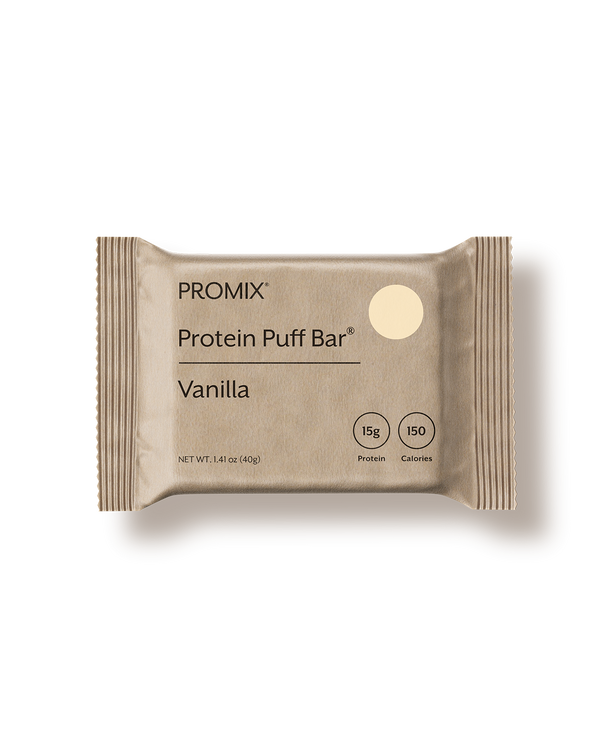
15g protein · 3g fat · 3g added sugar
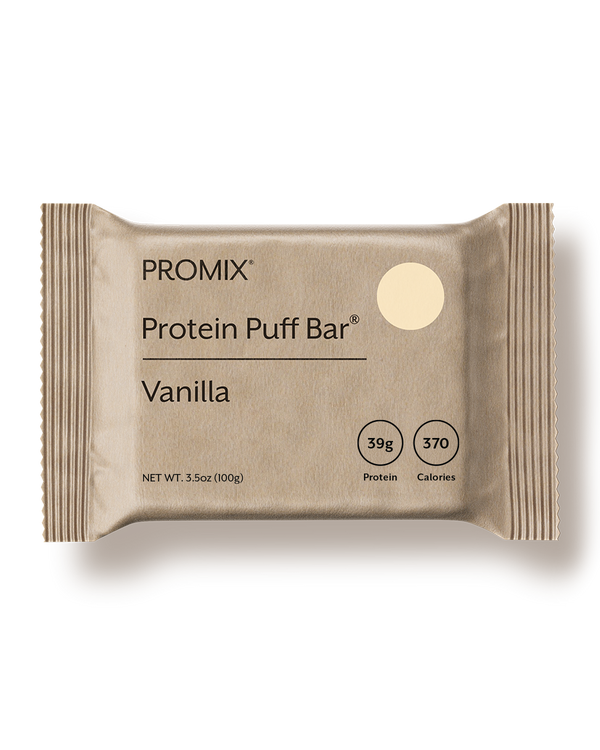
39g protein · 8g fat · 7g added sugar
Read from both live product pages, verified September 23, 2026.
The mechanism is not specific to whey either. The plant version puffs pea protein with rice starch and binds it in a vegan marshmallow. Same architecture, different inputs. If you want the background on the two whey fractions in the puff, we wrote about whey protein isolate versus concentrate separately.
The 2025 storage study found whey bars hardened fastest of the three proteins tested, and Promix's bar is whey based. Those were model bars, a homogeneous protein and syrup matrix rather than a puffed-then-bound bar, and nobody has tested whether that difference changes the storage behavior. We are not going to imply that it does.[2]
Four words get used loosely on bar packaging. Each one is produced by a different thing.
| Attribute | What produces it | What it costs you |
|---|---|---|
| Crispy | A puffed, low-density structure: small cells, thin walls, many of them. Crispness is a fracture that makes a sound.[1] | It is a moisture state, not a permanent one. Let water in and the sound goes, and the crispness goes with it.[1] |
| Soft and sticky | Added water. Two percent added water cut shear force and lowered both firmness and crispiness.[3] | You gain chew and lose crispness. In that trial the consumer panel preferred the firmer bars.[3] |
| Hard and dry | Time. Moisture leaves and protein cross-links, and each one makes the other worse.[2] | Whey bars lost 33 percent of their water over 42 days. Rice bars lost 12 percent.[2] |
| Sandy, the chalky one | The base recipe. Sandiness did not move when glycerol or added water changed across four builds.[3] | Adding moisture on its own does not fix it. The formulation has to change.[3] |
| Chewy | A binder that stays plastic at room temperature. | A real preference, and not what a puffed bar does. Promix's bar is not chewy. |
Sources 1, 2 and 3. Every row is a measured finding rather than a taste note.
If chewy is what you want, buy chewy on purpose. We are not going to tell you a puffed bar is something it is not.
No. It needs a binder that carries flavor, which is not the same thing as a sweetener system.
Worth being plain about this: the marshmallow in a Protein Puff Bar is a syrup system, and tapioca syrup is sugar. The Vanilla bar carries 4g of total sugars, of which 3g are added, in a 40g bar. Across the 40g line, added sugars run 3g to 5g. That is the honest number and it is on the panel.[5]
What does the work is tapioca syrup and tapioca fiber for the binder body, agar and egg whites to set the marshmallow, inulin contributing to the 5g of fiber, and organic vanilla extract sourced from Madagascar. What is not in it is stevia, xanthan gum, soy, gluten and GMOs. The bars are made in a peanut free facility and contain egg and milk.[5]
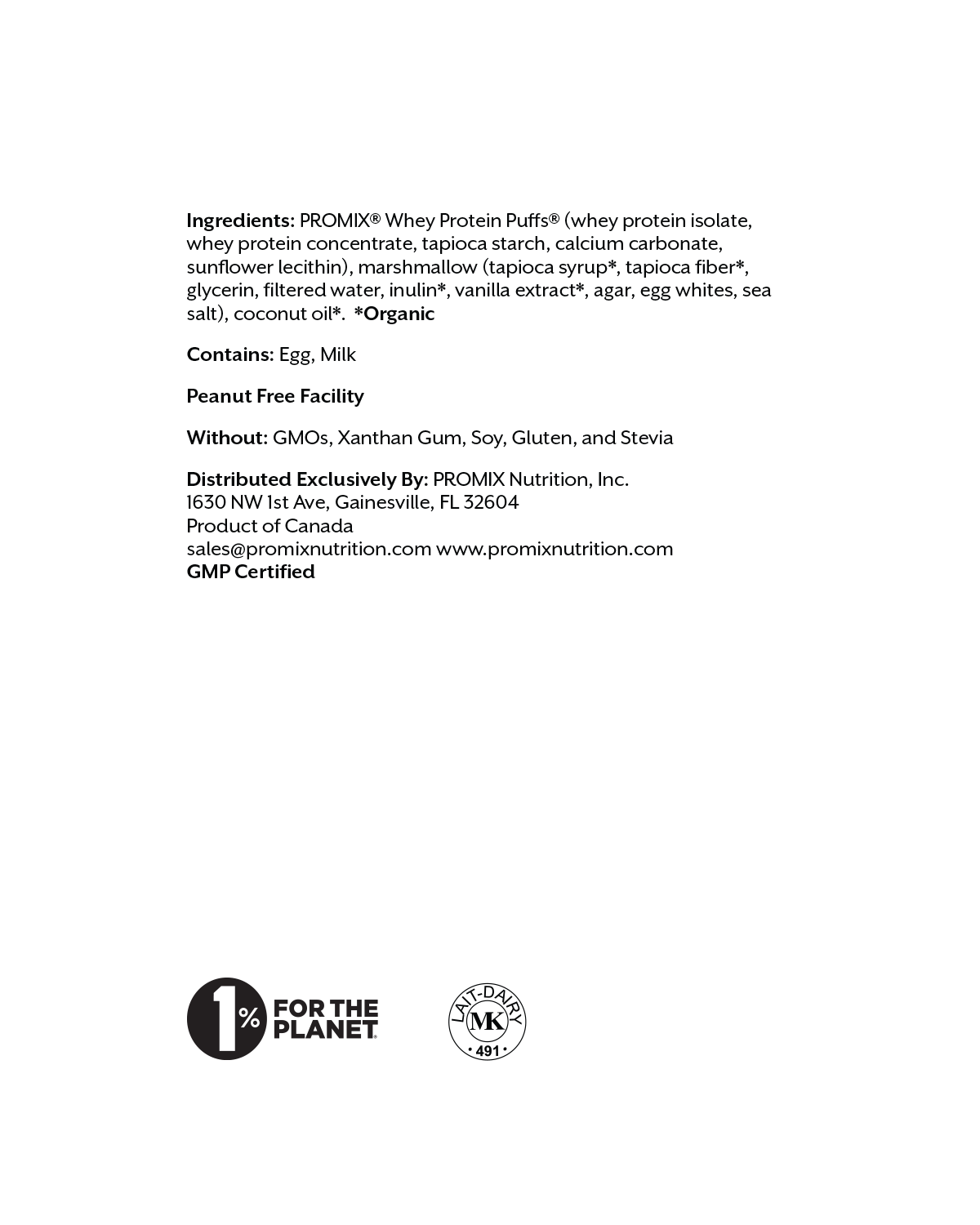
Three things, in order: the puff, the binder, the fat. Read from the live product page and verified September 23, 2026.
Promix's standing position is No Artificial Anything. That is a formulation rule rather than a health claim, and the panel is where you check it rather than the marketing.
Five lines on the back of the box tell you most of what the bar will feel like before you open it.
1. Total fat, read as a share of the bar's weight. Grams alone mean nothing until you divide by the serving size. 3g in a 40g bar is 7.5 percent. 3g in a 20g bar is a different product.
2. The first ingredient. A protein powder or concentrate first tells you the bar is a bound paste. A puff, crisp or extrudate first tells you the texture was built before the bar was.
3. The binder. Find the syrup, the fiber and the humectant. That is what is carrying the moisture, and it is where most of the sugar lives.
4. Added sugars, separately from total sugars. These are two different lines on the panel, and the gap between them is sugar that was already in the ingredients.
5. Whether anyone independent tested it. Specifications and methods, not a badge. We wrote a walkthrough of how to check if a supplement is third party tested.
None of these tell you whether you will like the flavor. They tell you what the bar is built from, which is the part a label can actually answer.
Most people do, and the ones who do not tend to dislike it for a specific reason worth knowing before you buy.
The Vanilla Protein Puff Bar carries a 4.89 average across 345 published reviews on Promix's own product page. The distribution is the part worth looking at.[5]
345 reviews, 4.89 average, read from the product page on September 23, 2026.
Zero three-star and zero two-star reviews out of 345. A distribution with an empty middle is what a texture preference looks like when you measure it.[5]
Two verified buyers, both reaching for the same comparison, landing in opposite places.
One star: "Taste like sawdust and was not anything like a rice crispy treat. Terrible texture and flavor."
Five stars: "They definitely can take the place of a Rice Krispie bar!! Wonderful flavor."
That is the whole split, in customers' own words. If you want a dense, chewy, fudgy bar, a puffed bar will read as light and airy and you will probably be disappointed. If a rice crisp treat sounds good and you want 15g of protein attached to it, this is built for you.
We would rather you knew that before you ordered than after.
Puffed, not pressed
15g of protein, 3g of fat and 5g of fiber in a 40g bar. Thirteen flavors, all built the same way.
Made in a peanut free facility. Contains egg and milk.
Chalkiness is a texture problem rather than a flavor one, and the term food scientists use for the closest sensation is sandiness. Two things drive it. Protein in a bar bonds to itself over time, and water leaves. A 2025 study in the Journal of Food Science measured whey bars losing 33 percent of their moisture over 42 days while free sulfhydryl content fell 44 percent, which is a marker of proteins cross-linking. A 2026 trial in Frontiers in Food Science and Technology found that sandiness tracked the base recipe rather than the glycerol or water level, which means adding moisture on its own does not fix it.
A protein puff bar is built from protein that is puffed before it is bound, rather than from protein powder mixed into a paste. The protein is extruded with a starch into light, thin-walled puffs, and the puffs are then held together with a binder. The mouthfeel comes from air and fracture instead of from fat. Promix Protein Puff Bars list PROMIX Whey Protein Puffs, which are whey protein isolate and whey protein concentrate with tapioca starch, as the first ingredient, followed by a marshmallow binder and coconut oil.
Neither is better in general, because they are built for different jobs. An energy bar is built around carbohydrate for fuel. A protein bar is built around protein, and it is the protein load that creates the texture problem this page is about. Read the panel rather than the category name. A 40 gram Promix Vanilla Protein Puff Bar carries 15 grams of protein and 17 grams of carbohydrate, so the numbers tell you more than the label on the box does.
There is no single answer, and any page that gives you one is guessing on your behalf. What you can do is read four lines on the panel: total fat as a share of the bar's weight, the first ingredient, the binder, and added sugars stated separately from total sugars. Then check whether anyone independent has tested it. Promix publishes its heavy metal, allergen and glyphosate specifications along with the methods used, and its gluten specification is under 5.0 ppm against the FDA standard of under 20 ppm for a gluten free claim.
As often as it fits the rest of what you eat, which makes it a question about your diet rather than about the bar. Promix's published positioning for the Protein Puff Bar is curbing cravings and supporting recovery, and the product page says it is great for eating at any time of day. A bar is a convenient way to add protein on a day you would otherwise skip it. It is not a replacement for a meal.
Cheng EM, Alavi S, Pearson T, Agbisit R. Mechanical-acoustic and sensory evaluations of cornstarch-whey protein isolate extrudates. J Texture Stud. 2007;38:473-504. www.ars.usda.gov
Read in full as the USDA ARS author copy.
Dietrich RB, Lincoln L, Momen S, Minkoff BB, Sussman MR, Girard AL. Role of protein and lipid oxidation in hardening of high-protein bars during storage. J Food Sci. 2025;90(1):e17657. pmc.ncbi.nlm.nih.gov
Open access, read in full. Model bars made in a laboratory, not commercial products. Three protein types, whey, pea and rice, over 42 days.
Vidal VAS, Hauge ES, Jensen I-J, Lerfall J. Effects of glycerol and water addition on the texture profile and consumer acceptance of protein bars. Front Food Sci Technol. 2026;6:1906637. www.frontiersin.org
Open access, read in full. Four formulations of one base recipe. Findings describe that base, not every bar.
University of Wisconsin-Madison, Department of Food Science. Soft, Chewy, Filling: UW Researchers Are Perfecting the Protein Bar. foodsci.wisc.edu
The plain-language write-up of source 2 by the group that ran it.
Promix Nutrition. Vanilla Whey Protein Puff Bars. Nutrition Facts, Key Ingredients, Testing and review panels. promixnutrition.com
Read from the live product page and verified September 23, 2026. All 13 flavors in the 40g line were read the same day.
Promix product facts read from the live product page and verified 2026-09-23. Nutrition Facts, Key Ingredients, Testing and review panels read the same day.


Detox Flush contains Niacin and WILL cause flushing and tingling. This is NORMAL.
DO NOT purchase Detox Flush if you are not comfortable with flushing and tingling.
DO NOT take a full serving your first time using Detox Flush. Take a 1/4 serving to understand how the tingling and flushing will feel.
For use ONLY by healthy individuals over 18 years old. Do not take if you are pregnant or nursing.