

































How Grass-Fed Whey Protein Is Made, and Whether It Is Actually Better
How whey protein is made, what the grass-fed label guarantees, and what it does not.
How whey protein is made, what the grass-fed label guarantees, and what it does not.

Promix Grass-fed Whey Isolate, Dutch Chocolate.
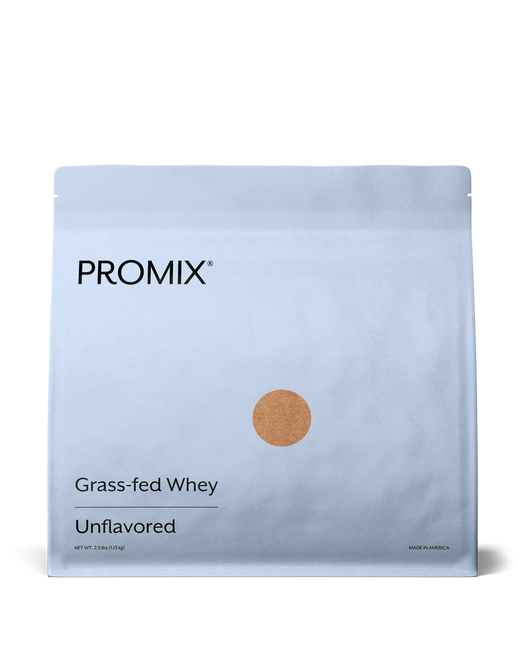
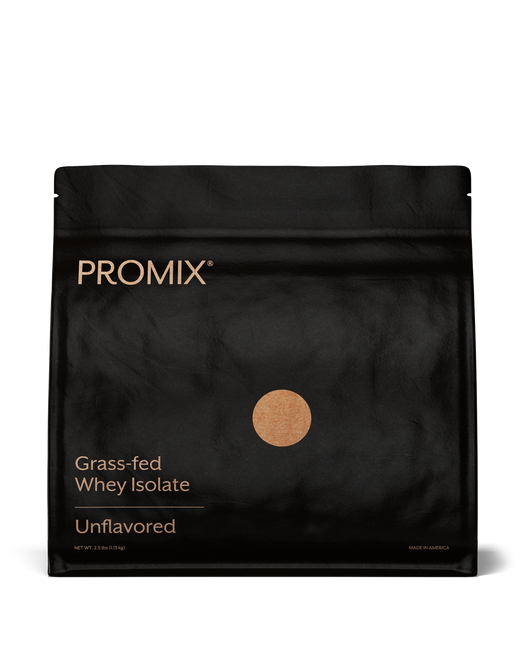
Grass feeding changes cows' milk in ways you can measure, and almost all of that change is in the fat. A whey protein powder is almost entirely not fat. Promix's own whey concentrate is 4.8 percent fat by serving weight and its isolate is 1.5 percent, so the part of the milk that grass feeding changes most is the part filtration removes. The label is accurate. It is describing the cows, not the powder.
Marginally, and less than the label suggests. Grass feeding makes a real, measurable difference to milk, but the difference lives in the milk fat, and a whey protein powder has had most of its fat removed on purpose.
Three things are true at once, and most pages on this subject only tell you the first one.
Grass-fed milk really is different. The difference is concentrated in the fatty acids. And whey protein powder is made by filtering milk down to its protein, which takes the fat out.
So the honest ranking is: the difference is largest in milk, smaller in a minimally filtered whey concentrate, and smallest in a whey isolate, which is the form most people buy. Sections 05 and 07 put numbers on that.
None of this makes a grass-fed label meaningless. It means the label is a claim about farming, and it should be judged as one.
It is whey protein from the milk of cows fed on grass and forage rather than mostly grain. The term describes how the animals were fed. It does not describe the powder.
That distinction matters more than it sounds. Every other claim on a tub of protein is about the powder: how much protein per scoop, how it was filtered, what it was tested for. Grass-fed is the one claim that is about something that happened before the milk ever reached a factory.
Promix states it plainly on its own pages. Its whey concentrate line says "Made from milk from grass-fed cows". Its isolate line says "Made from milk of grass-fed cows". Its One Ingredient whey says "Made from the milk of certified grass-fed cows" and "Farm-to-bag traceability standards on every batch".
Product claim wording read from promixnutrition.com, September 11, 2026.
What that tells you is what the cows ate. What it does not tell you is how much protein is in a scoop, how far the whey was filtered, or whether the finished powder was tested. Those are separate questions with separate answers, and section 06 comes back to them.
Whey is the liquid left over when milk is separated into curds and whey, which is what happens when cheese is made. Protein powder is that liquid, filtered and dried.
Whey is not manufactured on purpose so much as recovered. Cheese production is the source, and the volumes are not small: one published estimate is that every ton of cheese generates about nine tons of whey.
When milk splits, the two halves do not get an even share of what was in the milk. Roughly 96 percent of milk's soluble proteins and 94 percent of its lactose stay in the liquid whey, along with about 52 percent of the total solids and 38 percent of the minerals.
Figures from Brião and colleagues, Membranes, 2024. See Sources.
That is the first reason a whey powder is not a concentrated version of milk. It is a concentrated version of one fraction of milk, and which fraction you get is decided at the curd.
In four steps: milk is separated into curds and whey, the liquid whey is filtered through membranes that hold back protein and let water, lactose and salts through, the concentrate is dried into powder, and how far the filtering goes decides whether you end up with a concentrate or an isolate.
Milk is split into curds and whey. The curds become cheese. The whey is the liquid left behind.
The liquid whey is pushed through membranes that hold protein back and let water, lactose and salts through.
Stop early and you have a concentrate. Keep filtering and you have an isolate, with more protein and less of everything else.
What is left is dried into the powder that goes in the tub.
The general process, not a description of any one company's plant.
Membrane filtration is the step that does the work. Ultrafiltration is the standard method for recovering protein from whey: the membrane retains the protein while lactose, salts and water pass through. Push it further and you remove more of everything that is not protein.
Three phrases, and they are the whole published record. The concentrate line is described as "Minimally filtered". The isolate line is described as "Micro-filtered to under 1g of lactose for fast, easy digestion". The One Ingredient whey is described as "premium grass-fed native whey protein".
Where that leaves you in practice, which form to pick, is a different question from sourcing, and we answered it against digestion in whey isolate versus concentrate.
Those three phrases sit on a spectrum. Less filtering keeps more of what was in the whey besides protein, including the fat. More filtering takes it out, which is how you get lactose under a gram and 30 grams of protein in a 34 gram scoop.
Steps 1 to 4 above describe how whey protein is made in general. The three phrases in this subsection are Promix's own published wording, read September 11, 2026. Promix does not publish a fuller description of its process.
The cow's diet changes the fatty acid profile of the milk. Filtration decides how much of that fat is still there by the time it is powder. Those two facts pull in opposite directions, and the second one wins.
Start with what grass feeding does, because it is real and it is well measured. A review of pasture-based dairy systems published in 2026 puts it plainly: "The most substantial and identifiable impacts of pasture-based production are resolved in the fatty acid profile of milk."
The largest dataset on grass-fed milk specifically sampled 1,163 US milk samples over three years. Per 100 grams of milk it reported:
| Attribute | Grass-fed | Organic | Conventional |
|---|---|---|---|
| Total omega-3 | 0.049 g | 0.032 g | 0.020 g |
| Total CLA | 0.043 g | 0.023 g | 0.019 g |
| EPA | 0.0036 g | 0.0033 g | 0.0025 g |
| Omega-6 to omega-3 ratio | 0.95 | 2.28 | 5.77 |
Benbrook and colleagues, Food Science and Nutrition, 2018. 1,163 US milk samples over three years. See Sources.
Those are meaningful differences and they are not in dispute here. The question this post is about is what happens to them next.
That grass-fed milk carried 0.049 g of omega-3 and 0.043 g of CLA in 4.237 g of fat per 100 g of milk. Divide one by the other and you get roughly 0.0116 g of omega-3 and 0.0101 g of CLA per gram of milk fat.
Now take Promix's own Supplement Facts. A serving of the whey concentrate contains 1.5 g of fat. A serving of the isolate contains 0.5 g. So:
| Attribute | Fat per serving | Omega-3 ceiling | CLA ceiling |
|---|---|---|---|
| Promix whey concentrate | 1.5 g | about 17 mg | about 15 mg |
| Promix whey isolate | 0.5 g | about 6 mg | about 5 mg |
Our calculation, not a published finding. Fat per serving from Promix Supplement Facts, read September 11, 2026. Fatty acids per gram of fat derived from Benbrook 2018. These are ceilings: they assume every gram of fat in the powder is grass-fed milk fat and that filtering and drying change nothing.
For scale, and both of these reference points are sourced below. The US adequate intake for alpha-linolenic acid is 1.6 g a day for men and 1.1 g for women, so 17 mg is about 1 percent of the men's figure and about 1.5 percent of the women's. And 15 mg is about half of one percent of 3 g a day, which is the threshold a 2022 meta-analysis of 56 trials uses to separate lower-dose from higher-dose CLA supplementation.
We are not saying those amounts do nothing, and we are not saying they do something. We are saying how big they are.
There is no published study measuring the fatty acid profile of grass-fed versus conventional whey protein powder. We searched the biomedical literature on September 11, 2026. Every result was about milk, cheese or general reviews. None measured the powder.
So every number you will read in support of grass-fed whey protein, including the ones above, is a number about milk. The step from milk to powder is an inference. We have made ours in the open so you can check it.
The milk figures on this page come from the largest published dataset on grass-fed milk, and we think you should know who paid for it. That study was funded by CROPP Cooperative, the Sheepdrove Trust and an EU research program, and one of its authors is affiliated with Organic Valley / CROPP Cooperative, which sells grass-fed milk.
We still use it, for one reason: we use it for measured milk chemistry, which is the part funding does not bend, and we make no health claim from it. The arithmetic that turns those milk figures into per-serving figures is ours, and it points away from the conclusion a grass-fed marketer would want.
The pasture-based review quoted above is from Teagasc, Ireland's state agriculture and food authority, and University College Cork. Teagasc serves the Irish dairy sector, so we describe it as a state agri-food body rather than as independent.

It tells you what the cows ate. On its own it does not tell you how much protein is in a scoop, how the whey was filtered, or whether the finished powder was tested for anything.
A grass-fed claim is a claim about an input. It is made at the farm, and everything that happens after the farm sits outside it. That is not a criticism of the claim. It is the scope of the claim.
Which means a grass-fed label and a good protein powder are two separate things to check, and the second one is not implied by the first. The questions that decide whether a tub is worth buying are mostly downstream: how much protein per serving, how much lactose is left, what the ingredient list actually says, and whether anyone independent has tested the finished batch.
Those are answerable. A Supplement Facts panel answers the first three. Third-party testing answers the fourth, and we wrote a separate guide on how to check third-party testing. How much of that protein you actually need in a day is a separate question again, and we worked through it in how much protein you need in a day.
On protein, amino acids and how it mixes, there is no difference worth paying for. On the fat-soluble fraction there is a real difference in the milk that mostly does not survive into the powder.
The two forms this post keeps comparing. Same milk, different amounts of filtering.
| Attribute | Is there a difference? | Does it reach the powder? |
|---|---|---|
| Protein per serving | No | Not applicable |
| Amino acid profile | No meaningful difference | Not applicable |
| Omega-3 content | Yes, in the milk | Barely. About 17 mg at most in a concentrate serving |
| CLA content | Yes, in the milk | Barely. About 15 mg at most in a concentrate serving |
| Lactose per serving | No. Filtration decides this | Yes, and it is the filtering that decides it |
| How it mixes and tastes | No | Not applicable |
Protein and lactose rows from Promix Supplement Facts, September 11, 2026. Fatty acid rows from Benbrook 2018 and our own arithmetic in section 05. No published study has measured the fatty acid profile of grass-fed versus conventional whey protein powder.
Read the honest rows rather than the flattering ones. Four of the six say the difference is small or none, and the two that do not are both about fat.
The lactose row is the one that changes how a powder feels to drink. If that is your reason for reading this, our guide to whey protein and lactose goes further into it than this page does.


Concentrate on the left, isolate on the right. The fat line is the one this post turns on: 1.5 grams against 0.5.
Promix Supplement Facts panels, read at full resolution September 11, 2026.
Three product lines with three different claim sets, and the differences between them line up with everything above.
This is worth reading as a table, because the pattern is the argument. Promix claims omega-3s and CLA on its minimally filtered line and does not claim them on its micro-filtered line.
| Line | Sourcing | Filtering | What it claims is in there |
|---|---|---|---|
| One Ingredient | Milk of certified grass-fed cows, farm-to-bag traceability | Described as native whey | 25 g protein, 5.1 g BCAAs |
| Concentrate | Milk from grass-fed cows | Minimally filtered | 25 g protein, and omega-3s and CLA |
| Isolate | Milk of grass-fed cows | Micro-filtered to under 1 g of lactose | 30 g protein, 14.2 g essential amino acids |
Claim wording read verbatim from promixnutrition.com, September 11, 2026.
That is the correct way round. The concentrate keeps more of the fat, so it keeps more of what grass feeding changed. The isolate is filtered further, gives you more protein and less lactose per scoop, and carries less of the fat-soluble fraction with it. Neither is the better product in general. They answer different questions.
And if a protein shake has been sitting badly, the cause is usually something other than the cows. We went through the likely causes here.
If what you want is the most protein and the least lactose per scoop, that is the isolate. If you would rather keep the whey closer to how it left the milk, that is the minimally filtered concentrate.

25 g of protein in a minimally filtered concentrate, or 30 g with under 1 g of lactose in the isolate.
Figures from Promix Supplement Facts, September 11, 2026.
Whey protein isolate is whey that has been filtered further than a concentrate, so more of the lactose, fat and other non-protein material is removed. The result is more protein per scoop and less of everything else. Promix's isolate is described on its own pages as micro-filtered to under 1 gram of lactose, with 30 grams of protein in a 34 gram serving.
Yes. Whey comes from milk, and no animal is slaughtered to produce it, so it fits a vegetarian diet. Some cheesemaking uses animal-derived rennet, which is a separate question from the whey protein itself and is not something a Supplement Facts panel will tell you. If that matters to you, it is a question for the manufacturer.
Whey itself contains no gluten, because it comes from milk. What can change that is what else is in the tub: flavorings, thickeners and other added ingredients. The ingredient list is the place to check. Promix's unflavored whey concentrate lists grass-fed whey concentrate and sunflower lecithin, and its unflavored isolate lists grass-fed whey protein isolate and sunflower lecithin.
Yes. Whey contains all nine essential amino acids, which is what complete means. Promix publishes 14.2 grams of essential amino acids per serving on its whey isolate line. Grass feeding is not the reason whey is complete: that is a property of milk protein, and it is not something a change of diet alters.
For protein content per scoop and for the amino acid profile, whey generally does more per gram, because it is a complete protein and a concentrated one. Plant proteins can match it, usually by blending sources or by eating a larger serving. The better question is which one you will actually drink every day, because a protein you avoid does nothing. Diet, digestion and taste decide this more than the numbers do.
Not technically, but it is low. Filtering an isolate removes most of the lactose, which is why Promix describes its isolate as micro-filtered to under 1 gram of lactose per serving. Under a gram is far below the amount most people who are lactose intolerant react to, though it is not zero.
It can, and lactose is the usual reason, though it is not the only one. The amount of lactose left in a powder depends on how far it was filtered, which is why an isolate tends to sit easier than a concentrate. Added ingredients and simply drinking a shake too fast also play a part.
Whey is a natural fraction of milk, separated by filtration rather than synthesized. Natural is not a regulated term on a supplement label, so on its own it tells you very little. The ingredient list is the useful version of that question, and it takes about ten seconds to read.
Brião VB, Mossmann J, and colleagues. Integrating Whey Processing: Ultrafiltration, Nanofiltration, and Water Reuse from Diafiltration. Membranes, 2024. doi.org/10.3390/membranes14090191
Used for the cheese-to-whey ratio and the share of milk protein, lactose, solids and minerals that remain in whey, and for ultrafiltration as the standard protein recovery step. Open access, read in full.
Benbrook CM, Davis DR, Heins BJ, and colleagues. Enhancing the fatty acid profile of milk through forage-based rations, with nutrition modeling of diet outcomes. Food Science and Nutrition, 2018. doi.org/10.1002/fsn3.610
The source of every grass-fed milk fatty acid figure on this page. 1,163 US milk samples over three years. Open access, read in full. Funding disclosure: this study was funded by CROPP Cooperative, the Sheepdrove Trust and an EU research program, and one of its authors is affiliated with Organic Valley / CROPP Cooperative, which sells grass-fed milk. We use it for measured milk chemistry, which is the part industry funding does not bend, and we make no health claim from it.
Magan JB, Tobin JT, O'Callaghan TF, and colleagues. Compositional differences of milk from pasture-based systems compared with systems consuming large amounts of non-pasture feeds. JDS Communications, 2026. doi.org/10.3168/jdsc.2026-0987
Source of the quoted sentence on where pasture-based production shows up in milk. Authors are at Teagasc, Ireland's state agriculture and food authority, and University College Cork. Teagasc serves the Irish dairy sector, so we describe it as a state agri-food body rather than as independent. Open access, read in full.
Linehan K, Patangia DV, Ross RP, Stanton C. Production, Composition and Nutritional Properties of Organic Milk: A Critical Review. Foods, 2024. doi.org/10.3390/foods13040550
Carried as a counterweight. Found by checking which papers cite the 2018 grass-fed dataset critically, rather than by searching for agreement. Open access.
Lane KE, Wilson M, Hellon TG, Davies IG. Alpha-Linolenic and Linoleic Fatty Acids in the Vegan Diet: Do They Require Dietary Reference Intake / Adequate Intake Special Consideration? Nutrients, 2019. doi.org/10.3390/nu11102365
Source of the adequate intake figures for alpha-linolenic acid, 1.6 g a day for men and 1.1 g for women. Open access, read in full. We use it only for the reference figures it restates, not for its own conclusions about vegan diets.
Haghighatdoost F, Mahdavi A, Mohammadifard N, and colleagues. The effects of conjugated linoleic acid supplementation on lipid profile in adults: a systematic review and dose-response meta-analysis. Frontiers in Nutrition, 2022. doi.org/10.3389/fnut.2022.953012
Source of the 3 g a day figure. That is the dose threshold this meta-analysis of 56 randomized trials uses to split lower-dose from higher-dose CLA supplementation. Open access. We cite it for the dose threshold only. Its own findings on blood lipids are mixed and we make no claim from them.
Średnicka-Tober D, Barański M, Seal CJ, and colleagues. Higher PUFA and n-3 PUFA, conjugated linoleic acid, alpha-tocopherol and iron, but lower iodine and selenium concentrations in organic milk. British Journal of Nutrition, 2016. doi.org/10.1017/S0007114516000349
The organic milk meta-analysis this subject is usually argued from. Listed so you can see that organic and grass-fed are not the same comparison. It carries two published comments in the same journal, by Bath and Rayman and by Givens and Lovegrove. Neither comment is open access and we did not read either in full, so we attribute no finding to them.
Every figure on this page carries its source and the date it was read. Product figures were read from promixnutrition.com on September 11, 2026. Where a calculation is ours rather than a published finding, the page says so.


Detox Flush contains Niacin and WILL cause flushing and tingling. This is NORMAL.
DO NOT purchase Detox Flush if you are not comfortable with flushing and tingling.
DO NOT take a full serving your first time using Detox Flush. Take a 1/4 serving to understand how the tingling and flushing will feel.
For use ONLY by healthy individuals over 18 years old. Do not take if you are pregnant or nursing.