


































Does Creatine Make You Gain Weight? Water, Muscle, and How Much
Yes, a little. About 1.5 lb of lean mass across 35 trials, and the fast early part of it is largely water rather than muscle.
Yes, a little. About 1.5 lb of lean mass across 35 trials, and the fast early part of it is largely water rather than muscle.
Yes, a little. Across 35 randomized trials in 1,192 people, creatine increased lean body mass by 0.68 kg, about 1.5 lb.[1] A 2025 trial found that 0.51 kg of that, about 1.1 lb, arrives in the first week, before any training, which its authors read as a water effect rather than muscle built in seven days.[2] None of it is fat.
What we could not establish: how quickly it reverses when you stop. Every trial we read measured people while they were still taking it.
Yes, a little, and the best number we have is 0.68 kg of lean body mass, about 1.5 lb, pooled across 35 randomized trials in 1,192 people.[1]
The confidence interval runs from 0.26 to 1.11 kg, about 0.6 to 2.4 lb, so the real effect is somewhere in that band rather than at any single point.
What it is not is fat. Every measure above is lean body mass, the compartment that holds muscle and the water inside it.
The number also depends almost entirely on what else you are doing. Paired with resistance training it rises to 1.10 kg, about 2.4 lb. Taken on its own with no exercise at all it falls to 0.03 kg, under an ounce, which is nothing.[1]
| Study | Who | How long | What it found |
|---|---|---|---|
| Delpino 2022 meta-analysis[1] |
1,192 people across 35 randomized trials | varied | Lean body mass +0.68 kg, about 1.5 lb (95% CI 0.26 to 1.11 kg) |
| Desai 2025 randomized trial[2] |
63 adults, 34 women and 29 men | 13 weeks | +0.51 kg, about 1.1 lb, after a 7-day wash-in. No advantage after 12 weeks of training |
| Brooks 2023 randomized trial[3] |
13 female collegiate dancers | 6 weeks | Total body water rose 32.2 to 32.7 kg, about 71 to 72 lb; lean mass 39.8 to 41.5 kg, about 88 to 91 lb |
| Ribeiro 2020[4] | 27 resistance-trained men | 8 weeks | The intracellular-water-to-muscle ratio did not change |
All published between 2019 and 2025. Brooks 2023 had seven people on creatine, so we treat it as the small trial it is.
Both, and the newest trial suggests the fast early part is mostly a water effect.
A 2025 randomized trial gave 63 adults 5 grams a day. After a seven-day wash-in, before any training had started, the creatine group had gained 0.51 kg more lean body mass, about 1.1 lb, than controls.[2] Then both groups trained for twelve weeks and gained the same two kilograms, about 4.4 lb. Creatine added nothing further.
The authors read that early jump as creatine’s short-term effect on how lean body mass is measured, rather than as muscle built in a week. That is the honest reading and it is worth sitting with: the number on a body-composition scan moved before anyone lifted anything.
The water is real and measurable. In female collegiate dancers taking creatine for six weeks, total body water rose from 32.2 to 32.7 kg, about 71 to 72 lb, and lean mass from 39.8 to 41.5 kg, about 88 to 91 lb.[3] That trial had seven people on creatine, so treat it as a signal rather than a settlement.
Muscle is the slower half. Over eight weeks in 27 resistance-trained men, the ratio of intracellular water to muscle mass did not change, and changes in muscle and in intracellular water moved together.[4] In other words the water is not arriving on its own and sitting there. It comes with the tissue.
Every dot is an average and every bar is the range the true effect probably sits in. Where a bar crosses the no-effect line, the result is not statistically significant, which is the case for women during training, for mixed exercise, and for creatine taken without exercise at all.
Under a kilogram on average, about a pound and a half, and the fast part happens in about a week.
0.68 kg, about 1.5 lb, is the pooled figure across 35 trials.[1] The seven-day wash-in in the 2025 trial produced 0.51 kg, about 1.1 lb, of it before training even began,[2] so most of what people notice in the first fortnight arrives early and then stops.
On dose: across 685 trials the average was about 12.5 grams a day for a little over nine weeks.[7] That is a research dose. The current position stand for female athletes recommends 3 to 5 grams a day,[8] and one Promix serving is 5 grams. When in the day to take it is a separate question, and we answered it in when to take creatine.
One figure you will see quoted everywhere is 0.5 to 1.0 liters of fluid retention. We went looking for its source and could not stand it up: the position stand that popularized it cites two papers by the same author, and the figure appears in neither abstract. We are not going to repeat a number we could not trace.
One stick, five grams
Research doses run more than twice that.

Nobody has published the answer, and that is worth saying plainly.
The trials are not short. They run six weeks, eight weeks, thirteen weeks; the 2025 safety analysis pooled 685 studies averaging about nine weeks each, some lasting years.[7] Length is not the gap.
The gap is that every one of them measured people while they were still taking creatine. None of the studies we read reported following participants after they stopped.
So there is no washout figure here to give you. The mechanism, water held alongside muscle while muscle creatine is elevated, makes it reasonable to expect the water to go when the supplementation does. Reasonable is not the same as measured, and we are not going to present one as the other.
These are real study lengths, not a shortage of research. The shaded area is not a finding, it is an absence, the question nobody in this set asked.
No. If anything the measured movement is slightly the other way.
A meta-analysis of 19 studies in 609 adults aged 50 and over found that creatine plus resistance training reduced body fat percentage by 0.55 percent compared with resistance training alone.[5]
Two honest caveats ship with that. The fat mass difference, about half a kilogram or one pound, was not statistically significant. And the population is adults over 50, which is narrower than the people reading this.
You may also see laboratory work on creatine metabolism inside fat tissue cited as evidence that creatine burns fat. It does not support that. Those are genetic studies in animal models of how fat cells handle creatine, not studies of people taking a scoop of it.
Three different things get called bloating here, and separating them is the whole answer.
One: water held with muscle. That is what has been measured, and it sits in the muscle, not in your gut.[3][4]
Two: stomach upset from creatine itself. Here two 2025 reviews disagree, and we are going to show you the disagreement rather than pick the convenient side. One concludes gastrointestinal distress is reported by some people, particularly at high doses, and is dose-dependent rather than universal.[6] The other, pooling 685 trials, found GI issues in 5.5 percent of creatine participants against 4.1 percent on placebo, not a statistically significant difference.[7]
The practical read: if you are taking a research-sized dose and feeling it, the dose is the thing to change. At 3 to 5 grams a day the trial evidence does not show a meaningful difference from placebo.
Three: digestive bloating, which is its own subject. It has causes that have nothing to do with creatine, and we wrote about those separately in why am I so bloated. If your bloating started before the creatine did, that is the more useful place to begin.
One thing both reviews agree on: claims that creatine causes dehydration or muscle cramps during exercise are not supported by the controlled studies.[6][7]
Not meaningfully, and the one real signal is small and in a narrow population.
The honest picture is the body fat percentage finding above: 0.55 percent lower with creatine plus resistance training, in adults over 50, with the fat mass difference not reaching significance.[5] That is a real result and it is a small one.
Everything else points the other way on the scale. Creatine adds lean body mass, and the meta-analysis is clear that without exercise it adds essentially nothing at all, 0.03 kg, under an ounce.[1] It is not a weight-loss supplement and we are not going to sell it as one.
If your goal is fat loss and you are worried the scale will move the wrong way, the useful framing is that the early increase is water and lean tissue rather than fat. The number on the scale and the change in your body composition are not the same story.
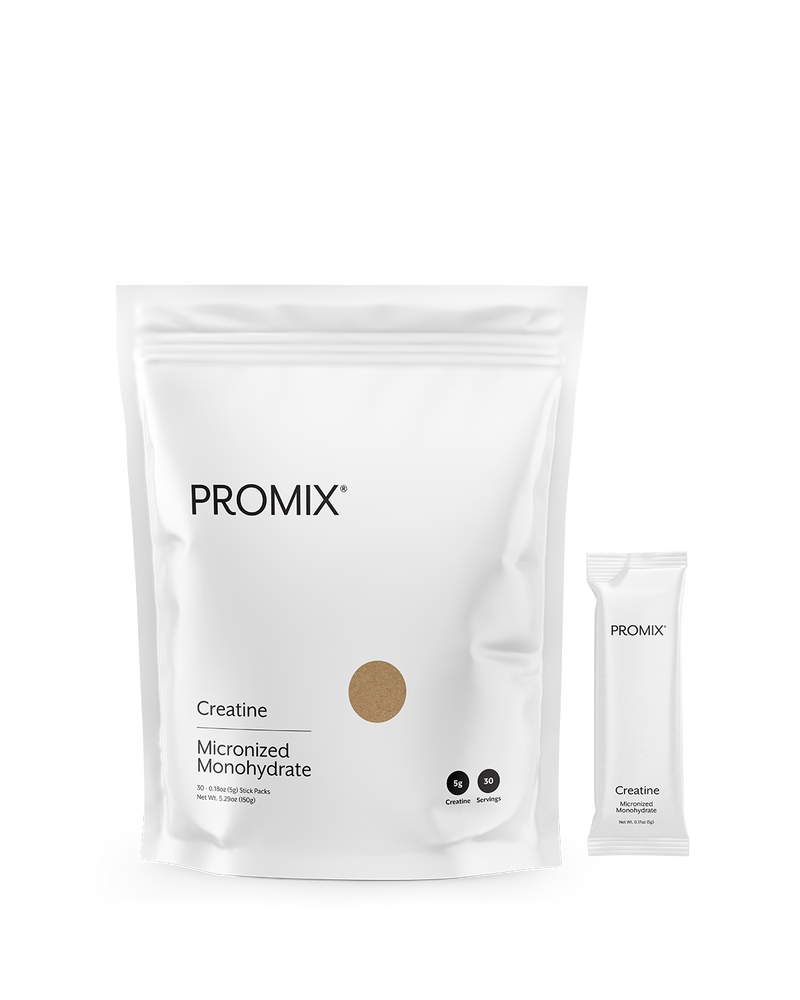
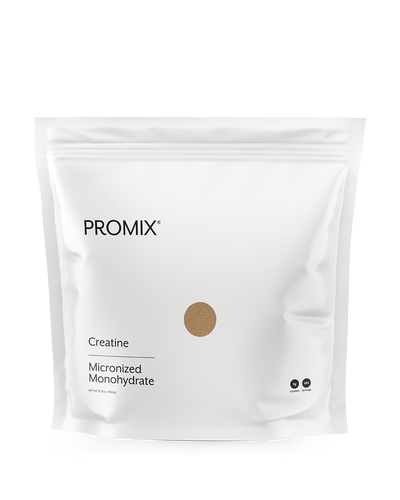
Promix Non-GMO Creatine is micronized creatine monohydrate, unflavored.
The product page reads “Micronized Creatine Monohydrate”, “Unsweetened, smooth and flavorless” and “Safely supports increases in muscular size, strength and power*”. Verified in the page source on September 21, 2026.
It comes as 90 servings, 180 servings, or 30 single stick packs at 5 grams each, which is 150 grams in the box. Five grams is the dose the current female-athlete position stand recommends.[8]
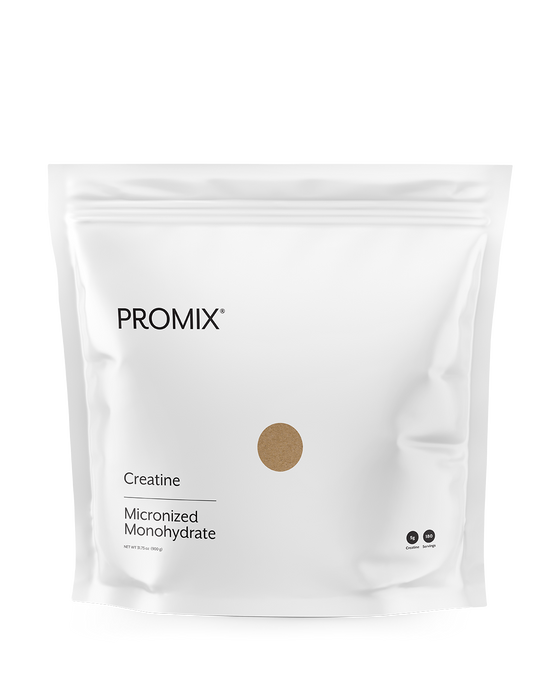
The pouch
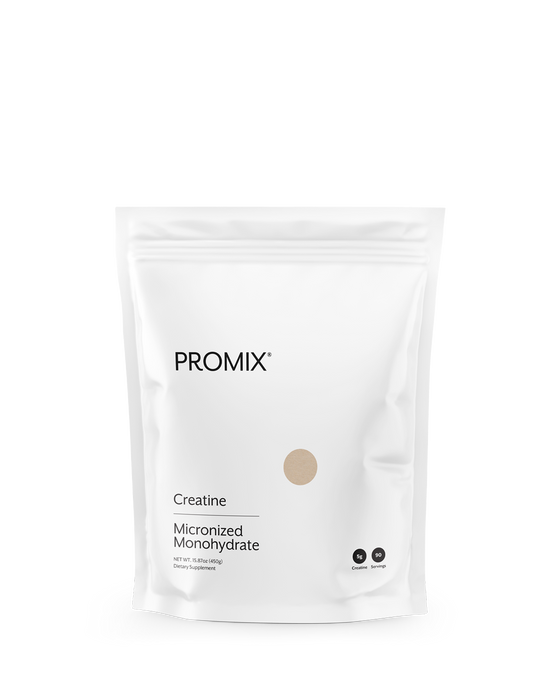
The smaller pouch
Same powder as the stick packs, different format.

One ingredient, 5 g a serving, and no daily value established because none exists for creatine. Verified September 21, 2026.
If you want the comparison between creatine forms rather than the weight question, that is in creatine HCl vs monohydrate. The other worry people raise most, hair loss, is in does creatine cause hair loss.
Ninety, one eighty, or sticks
30 single stick packs is 150 grams in the box.
Pooling 35 randomized trials in 1,192 people, creatine increased lean body mass by 0.68 kg on average, about 1.5 lb, with a confidence interval of 0.26 to 1.11 kg, about 0.6 to 2.4 lb. Paired with resistance training the figure rises to 1.10 kg, about 2.4 lb. Taken without any exercise it falls to 0.03 kg, under an ounce.
We could not find a trial that followed people after they stopped. The studies we read ran for six to thirteen weeks and measured people while they were still taking it, so anyone who tells you exactly how fast it reverses is going beyond the published evidence.
The studies we read do not answer it. They measured what happens during supplementation, not what happens after it stops. What they do show is that the fast early gain and the slow later gain are different things.
No study we read measured facial appearance. What has been measured is total body water and the water held inside muscle cells, which is not the same thing as fluid under the skin of the face.
No. A meta-analysis of 19 studies in adults over 50 found body fat percentage fell by 0.55 percent with creatine and resistance training compared with training alone. The fat mass difference, about half a kilogram or one pound, was not statistically significant.
Creatine increases lean body mass, and part of that is water held inside muscle. In one trial in female dancers, total body water rose about half a kilogram, roughly a pound, over six weeks. Whether that reads as looking bigger is a question about appearance, and the studies did not measure appearance.
Yes, some. Total body water rose measurably in a six-week trial in female collegiate dancers. A separate eight-week study in resistance-trained men found the ratio of intracellular water to muscle mass did not change, which suggests the water and the muscle grow together rather than the water arriving on its own.
We cannot tell you from the evidence we have. None of the trials we read reported following participants after they stopped taking creatine.
You should know where evidence about supplements comes from, because in this field a lot of it is paid for by people who sell supplements.
Every source here was published between 2019 and 2025. We removed four older papers while writing this, including the trials that are usually quoted for creatine and water weight. They were between nine and twenty-six years old.
Two of our sources disagree, and section 06 shows you the disagreement rather than resolving it quietly. One is a Brazilian review whose science was financed by two public research funders, with the article processing charge paid by AlzChem, a creatine manufacturer.[6] The other is by an author who chairs AlzChem’s scientific advisory board on creatine, and it reaches the more favorable conclusion.[7] We have cited both and told you which is which.
Two of the eight sources are paywalled and we could not retrieve funding statements for them.[1][4] We would rather tell you that than imply we checked.
Delpino FM, Figueiredo LM, Forbes SC, Candow DG, Santos HO. Influence of age, sex, and type of exercise on the efficacy of creatine supplementation on lean body mass: a systematic review and meta-analysis of randomized clinical trials. Nutrition. 2022;103-104:111791. doi:10.1016/j.nut.2022.111791
Paywalled; funding statement not retrievable. Two authors, Candow and Forbes, recur across the creatine literature including source 5.
Desai I, Pandit A, Smith-Ryan AE, Simar D, Candow DG, Kaakoush NO, Hagstrom AD. The effect of creatine supplementation on lean body mass with and without resistance training. Nutrients. 2025;17(6):1081. doi:10.3390/nu17061081
Open access. Funding statement not yet read at publisher; recorded as unverified.
Brooks SJ, Candow DG, Roe AJ, et al. Creatine monohydrate supplementation changes total body water and DXA lean mass estimates in female collegiate dancers. J Int Soc Sports Nutr. 2023;20(1):2193556. doi:10.1080/15502783.2023.2193556
Open access. Thirteen participants, seven of them on creatine. A very small trial and we treat it as one.
Ribeiro AS, Avelar A, Kassiano W, et al. Creatine supplementation does not influence the ratio between intracellular water and skeletal muscle mass in resistance-trained men. Int J Sport Nutr Exerc Metab. 2020;30(6):405-411. doi:10.1123/ijsnem.2020-0080
Paywalled; funding statement not retrievable.
Forbes SC, Candow DG, Krentz JR, Roberts MD, Young KC. Changes in fat mass following creatine supplementation and resistance training in adults ≥50 years of age: a meta-analysis. J Funct Morphol Kinesiol. 2019;4(3):62. doi:10.3390/jfmk4030062
Open access. Population is adults aged 50 and over, which is narrower than this article’s readership.
Longobardi I, Solis MY, Roschel H, Gualano B. A short review of the most common safety concerns regarding creatine ingestion. Front Nutr. 2025;12:1682746. doi:10.3389/fnut.2025.1682746
Science financed by FAPESP and CNPq, Brazil’s public research funders. AlzChem, which manufactures creatine monohydrate, paid the article processing charge only.
Kreider RB, Gonzalez DE, Hines K, Gil A, Bonilla DA. Safety of creatine supplementation: analysis of the prevalence of reported side effects in clinical trials and adverse event reports. J Int Soc Sports Nutr. 2025;22(1):2488937. doi:10.1080/15502783.2025.2488937
The lead author chairs the Scientific Advisory Board on Creatine for AlzChem, a creatine manufacturer, as disclosed in his other work. This paper reaches a more favorable conclusion on side effects than source 6 does.
Sims ST, Kerksick CM, Smith-Ryan AE, et al. International Society of Sports Nutrition position stand: nutritional concerns of the female athlete. J Int Soc Sports Nutr. 2023;20(1):2204066. doi:10.1080/15502783.2023.2204066
Open access. Reports no funding and no conflict of interest.
This article is general information, not medical advice. Caution is advised for anyone with a pre-existing kidney condition and for people who are pregnant, because the evidence in those groups is lacking.[6]


Detox Flush contains Niacin and WILL cause flushing and tingling. This is NORMAL.
DO NOT purchase Detox Flush if you are not comfortable with flushing and tingling.
DO NOT take a full serving your first time using Detox Flush. Take a 1/4 serving to understand how the tingling and flushing will feel.
For use ONLY by healthy individuals over 18 years old. Do not take if you are pregnant or nursing.