Can You Drink Electrolyte Water Every Day? Who Actually Needs It
Most people can. Few need to. Here is who actually does, with the numbers. (And who doesn't.)
Most people can. Few need to. Here is who actually does, with the numbers. (And who doesn't.)
You can drink electrolyte water every day, but most people don't need to, and a daily drink adds sodium to an average American diet that is already over the limit.[1]
The 2025-2030 Dietary Guidelines set that limit at less than 2,300 mg of sodium a day for anyone 14 or older, and Americans eat about 3,400 mg on average.[2][1] The guidelines also say highly active people may benefit from more sodium to offset sweat losses. Those are the people a daily drink is for.[2]
Promix sells an electrolyte mix, so we have an interest in the answer. This guide says who does not need one, and sections 06 and 08 run the math on our own label.
Electrolytes are minerals that carry an electric charge when they dissolve in body fluids, including sodium, potassium, magnesium, calcium and chloride, and you get them from the food you eat and the fluids you drink.[3]
MedlinePlus, the National Library of Medicine's health site, lists seven main ones: bicarbonate, calcium, chloride, magnesium, phosphate, potassium and sodium. They help balance the water in your body, move nutrients into your cells and support muscle and nerve function.[3]
Do you need to drink them? Under normal circumstances, no. The National Athletic Trainers' Association, in its position statement on fluid replacement, says active people eating a well-balanced diet “should not need to add specific ingredients to their fluids.”[4]
Sweat is the exception. FDA describes sodium as needed “in relatively small amounts (provided that substantial sweating does not occur).”[1] The rest of this guide is about that parenthesis.
Most people get enough electrolytes from food,[3][4] and for potassium, ordinary foods beat an electrolyte drink: a medium baked potato has more than four times the potassium of a Promix serving.[5][6]
The table sets five everyday foods from USDA data next to one serving of Promix. Every food in it beats the serving on potassium, and Promix wins on sodium, which is the point of it.
| Food, serving | Sodium | Potassium | Magnesium |
|---|---|---|---|
| Banana, raw1 medium, 118 g | 1 mg | 422 mg | 32 mg |
| Plain low-fat yogurt1 cup, 245 g | 172 mg | 573 mg | 42 mg |
| Baked potato, with skin1 medium, 173 g | 17 mg | 926 mg | 48 mg |
| Spinach, cooked1 cup, 180 g | 126 mg | 839 mg | 157 mg |
| Coconut water1 cup, 240 g | 252 mg | 600 mg | 60 mg |
| Promix Electrolytes1 serving | 1,000 mg | 200 mg | 60 mg |
Foods: USDA FoodData Central, SR Legacy, per serving at USDA's portion weights; real foods vary.[5] Promix: the Supplement Facts panels, read September 26, 2026.[6]
Magnesium is mixed. A cup of cooked spinach has more than twice a serving's 60 mg and coconut water matches it, while the banana, yogurt and potato have less.
If potassium is what you are after, eat it. NIH's adequate intake for adults is 3,400 mg a day for men and 2,600 mg for women,[7] and one potato covers more than a quarter of either.
A drink earns its place in the middle of a long, hot session, when you are losing sodium and a potato is not practical.

From the Promix Salted Watermelon gallery. The salt supplies the sodium; the watermelon is a natural flavor, not fruit.
Tap water carries only trace electrolytes, about 7 mg of sodium in an 8-ounce glass by USDA's average, and plain water is still enough for most people most of the time.[5]
NATA puts it simply: people exercising for less than an hour “should require no substances other than water.”[4] For everyday drinking, the Dietary Guidelines say to choose water, still or sparkling, and unsweetened drinks.[2]
The best test of whether anything beats water is a 2016 trial that measured how much of a drink the body keeps. Healthy men drank 1 liter, about 34 ounces, of still water and, on separate visits, of three other drinks from a list of 12, and researchers weighed the urine they passed over the next four hours.[8]
An oral rehydration solution and both milks left 285 to 299 grams less urine than water, about 10 ounces. A sports drink did not: it was no different from water, and neither were cola, coffee, tea, lager or sparkling water.[8]
Grams. Less urine means more of the drink stayed in the body. Bars to scale, from zero.
Maughan and colleagues, 2016: 72 healthy men, fasted and at rest. A sports drink and eight other drinks did not differ from water at 4 hours. Funded by the European Hydration Institute.[8]
Read it with its limits. The 72 men were resting, not sweating, and the trial was funded by the European Hydration Institute, whose scientific advisory board the lead author chaired.[8] It says nothing about daily use.
You are most likely to need more than water when you exercise for more than an hour or in hard intervals, especially in heat, sweat heavily at work, or lose a lot of salt in your sweat.[4]
Those lines come from NATA's 2017 statement: under an hour, water; past an hour, or in intense intervals, electrolytes “may benefit” you, “especially in extreme environments.”[4] Advice online puts the line anywhere from one hour to two, and we use NATA's hour because it comes from a peer-reviewed statement.
Illness is a different case. For diarrhea, WHO's treatment is oral rehydration solution, “a solution of clean water, sugar and salt,” and the right call is a doctor, not a sports drink or an electrolyte mix like ours.[9]
Before or after a workout? For a normal session, neither: NATA says active people on a balanced diet should not need added ingredients “before, during, or after activity,” and it notes that meals contribute to fluid replacement.[4] The case for electrolytes is the long, hot session itself.
Sweat carries about 10 to 100 mEq of sodium per liter, roughly 230 to 2,300 mg by our conversion, so two people doing the same workout can lose very different amounts.[4]
NATA puts sweat rates at 0.5 to 4.0 liters an hour, about 17 to 135 ounces, and sodium losses at 200 to 7,300 mg an hour.[4] “Salty sweater” is the high end: sweat above 60 mEq per liter at more than 2.5 liters an hour, about 85 ounces, where NATA says extra sodium may help. Beyond your own losses, it says, there is no evidence that it does.[4]

Promix Salted Pineapple. Long, hot days are when sweat losses add up.
You can estimate your sweat rate with a scale, using the method in Table 2 of NATA's statement. The American College of Sports Medicine describes the same approach.[4][10]
Right before the session, on the scale you will use after.
Measure every drink during the session, in liters or ounces.
The equation subtracts any you pass during the session.
Towel off, then use the same scale.
Weight before, minus weight after, plus what you drank, minus any urine, is your sweat loss. A kilogram is about a liter, and a pound is about 15 fluid ounces. Divide by the hours you trained for your sweat rate.
One session is one reading: heat, pace and fitness change it, and your sweat gets less salty as your body adapts to heat.[4] A scale measures how much you sweat, not how salty it is, and salt marks on a hat don't measure that either. A sweat test does.
No official guideline sets a number of electrolyte drinks a day, so count sodium instead: one serving of Promix has 1,000 mg, about 43% of the 2,300 mg daily limit.[2][6]
Milligrams of sodium. Bars to scale, from zero.
Our arithmetic: two servings is 2,000 mg, 87% of the limit, and three is 3,000 mg, 130%. Add one serving to the average American's 3,400 mg and the day comes to 4,400 mg, nearly twice the limit.[1][2]
The limit is written for the general population, and the guidelines themselves carve out highly active people.[2] Sweat changes the math. By our arithmetic, 1,000 mg is the sodium in about 0.43 liters of very salty sweat at 100 mEq per liter, roughly 15 ounces, or 4.35 liters of low-sodium sweat at 10 mEq per liter, more than a gallon.[4]
So on a desk day, one serving is a lot of sodium. On a long day in the heat, it may be less than you lost. The number depends on your sweat, not on the calendar.
Yes, you can get too much of an electrolyte, from too much sodium over the long run to too much potassium for people whose kidneys or medications limit how much they can clear.[1][7]
Sodium is the long-run risk. FDA notes that diets higher in sodium are associated with an increased risk of developing high blood pressure.[1] Whether salt makes you bloated is a separate question, and we answer it in why am I so bloated.
Potassium is different. NIH notes that for people whose kidneys do not clear potassium well, or who take certain medications such as ACE inhibitors or potassium-sparing diuretics, even potassium from food can push blood levels too high.[7]
For magnesium, NIH sets the adult upper limit from supplements at 350 mg a day, and notes that high doses can cause diarrhea, nausea and abdominal cramping.[11] A serving of Promix has 60 mg.
In endurance events there is a risk that runs the other way: too much fluid. NATA's recommendation, graded A, its strongest, is that low blood sodium during exercise is caused by drinking too much low-sodium fluid, “including sports drinks,” and that you should not drink more than you lose.[4]
Ask a doctor before drinking electrolytes every day if you have kidney or blood pressure problems, or take medications for either. Children have lower sodium limits, under 1,200 mg a day at ages 1 to 3 and under 1,800 mg at 9 to 13, so one 1,000 mg serving is most of a young child's day.[2]
A serving of Promix Electrolytes has 1,000 mg of sodium, 200 mg of potassium and 60 mg of magnesium, and it is made for days you sweat a lot.[6]
The panel below is Lemon Lime, and its ingredients are Himalayan pink salt, citric acid, magnesium malate, malic acid, potassium chloride, natural lemon lime flavor, monk fruit, ascorbic acid, lemon juice powder and turmeric for color.[6] It is lightly sweetened with monk fruit: no stevia, no cane sugar, 0 grams of sugar. No Artificial Anything.
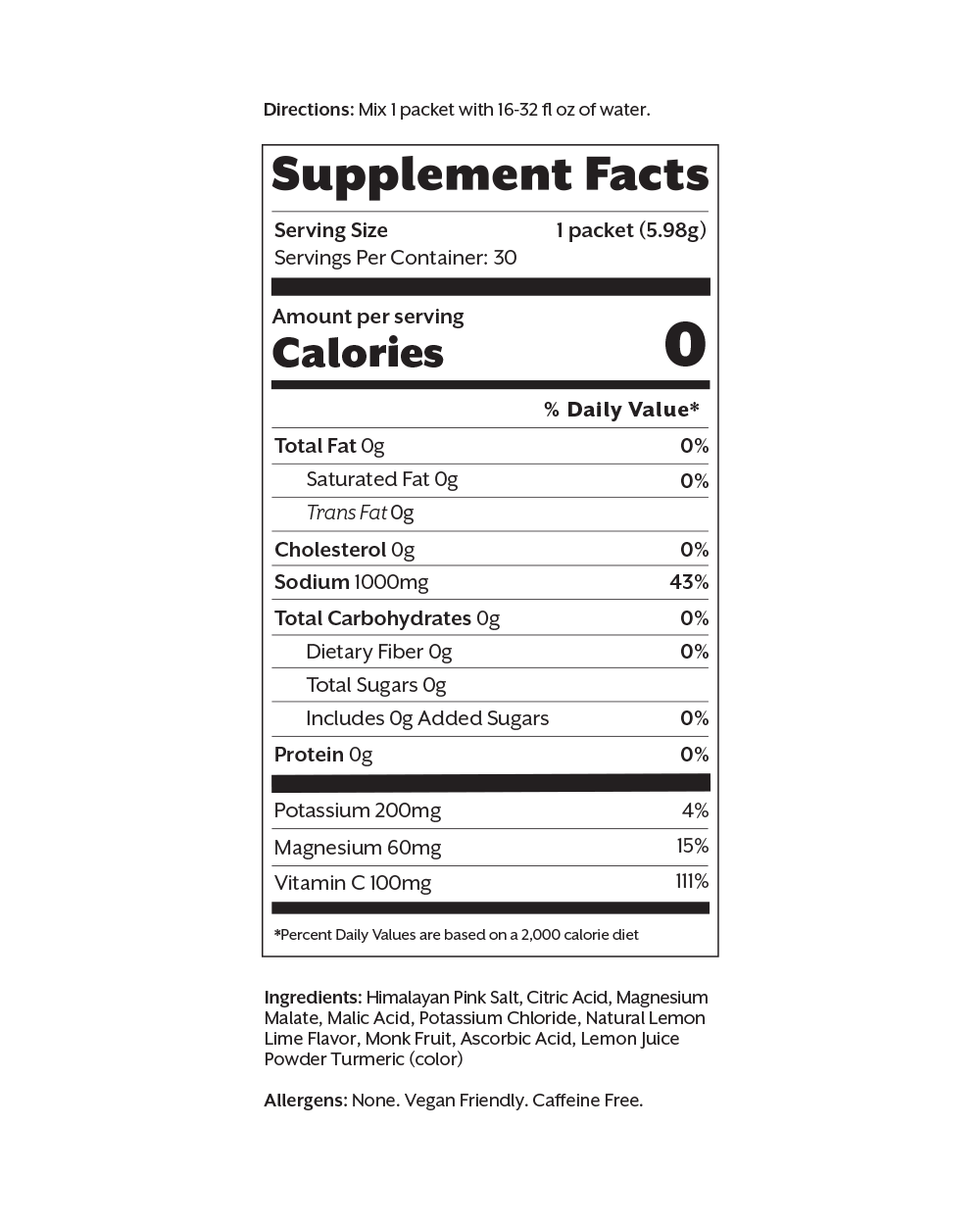
Promix Lemon Lime, 1 packet, 5.98 g. This is the panel on the formula Promix ships, confirmed by Promix on October 8, 2026.
Our product pages say to use it “for your daily electrolyte needs,” and here is who that fits.[6] If you train for more than an hour, work outside in the heat or sweat heavily most days, a serving a day can fit. If you sit at a desk and train for 45 minutes, you do not need one every day, and section 06 shows why.
The Testing tab on each product page lists the limits Promix tests to, including under 5.00 ppb for lead and mercury by ICP mass spectrometry.[6] Those are limits, not batch results, and the lot lookup on our lab results page confirms the lot code on your pack and shows the same limits.[12] The full line is on our electrolyte drink mix page.
Promix Electrolytes
1,000 mg sodium, 200 mg potassium and 60 mg magnesium a serving. Salted Pineapple, Lemon Lime and Salted Coconut, 12 sticks.
Lightly sweetened with monk fruit. No stevia or cane sugar.

Yes. A cup of coconut water straight from the coconut has about 252 mg of sodium, 600 mg of potassium and 60 mg of magnesium, with 46 calories, according to USDA. That makes it high in potassium and modest in sodium: about a quarter of the sodium in a Promix serving, and three times the potassium. Packaged coconut water varies by brand, so read the label on the one you buy.
Salt is sodium chloride, and both sodium and chloride are electrolytes. MedlinePlus lists both among the main minerals that carry an electric charge in body fluids. Salt is one of the three ingredients in the oral rehydration solution WHO recommends for diarrhea, with clean water and sugar. It is also the first ingredient in Promix Lemon Lime, as Himalayan pink salt.
Very little. A cup of lemonade made from frozen concentrate has about 10 mg of sodium, 37 mg of potassium and 5 mg of magnesium, with 99 calories, according to USDA. Homemade lemonade varies with the recipe. Add a pinch of salt and it carries more sodium, which is close to what a homemade electrolyte drink is.
For most people, by eating and drinking normally, since you get electrolytes from the foods you eat and the fluids you drink. After a long, sweaty session, a meal and water usually cover it, and NATA's position statement notes that meals contribute to fluid replacement. An electrolyte drink is the convenient option when you sweat heavily for more than an hour, especially in heat. For losses from vomiting or diarrhea, use an oral rehydration solution and talk to a doctor.
The simplest way is salt. A pinch in a glass of water adds sodium, and citrus adds flavor. What a mix adds is a measured dose. One serving of Promix Electrolytes goes in 16 to 32 fluid ounces of water, as the product page directs, for 1,000 mg of sodium, 200 mg of potassium and 60 mg of magnesium. Use less water for a stronger flavor.
No. Sugar is not a mineral and carries no electric charge, so it is not an electrolyte. It still shows up in rehydration drinks: WHO describes oral rehydration solution as a solution of clean water, sugar and salt, used to replace the water and electrolytes lost to diarrhea. Promix Electrolytes has 0 grams of sugar, and our Lemon Lime is lightly sweetened with monk fruit.
Yes. Magnesium is one of the main electrolytes MedlinePlus lists, along with sodium, potassium, calcium, chloride, phosphate and bicarbonate. NIH puts adult needs at 310 to 420 mg a day, depending on age and sex. A serving of Promix Electrolytes has 60 mg, from magnesium malate. A cup of cooked spinach has about 157 mg.
Large doses can. NIH notes that high doses of magnesium from dietary supplements or medications can cause diarrhea, nausea and abdominal cramping, and it sets the adult upper limit for supplemental magnesium at 350 mg a day. A serving of Promix Electrolytes has 60 mg. If a drink keeps upsetting your stomach, stop and talk to a doctor.
US Food and Drug Administration. Sodium in Your Diet. Content current as of March 5, 2024. www.fda.gov
Consumer guidance. Read September 26, 2026.
US Department of Agriculture and US Department of Health and Human Services. Dietary Guidelines for Americans, 2025-2030. Pages 2 and 5. cdn.realfood.gov
Read September 26, 2026. The 2,300 mg sodium limit is for the general population, ages 14 and above; children's limits are lower.
MedlinePlus, National Library of Medicine. Fluid and Electrolyte Balance. Last updated May 16, 2024. medlineplus.gov
Consumer health reference. Read September 26, 2026.
McDermott BP, Anderson SA, Armstrong LE, et al. National Athletic Trainers' Association Position Statement: Fluid Replacement for the Physically Active. J Athl Train. 2017;52(9):877-895. doi.org
A position statement that reviews the research and grades its recommendations, not a single trial. Read in full at the publisher. Several authors disclose consulting or funding ties to sports-drink and beverage companies. No correction on record.
US Department of Agriculture, Agricultural Research Service. FoodData Central, SR Legacy (April 2018). fdc.nal.usda.gov
Records 173944 (banana), 170886 (yogurt), 170093 (potato), 168463 (spinach), 170174 (coconut water), 173217 (lemonade) and 175103 (tap water), read September 26, 2026. Per-serving figures use USDA's own portion weights. Real foods vary.
Promix Nutrition. Electrolyte Drink Mix product pages: Supplement Facts, Ingredients and Testing tabs. promixnutrition.com
Read September 26, 2026. The Lemon Lime, Salted Pineapple, Salted Coconut and Unflavored panels each list 1,000 mg sodium, 200 mg potassium and 60 mg magnesium a serving. The Lemon Lime ingredients are read from the 5.98 g Supplement Facts panel in the Lemon Lime product page gallery, October 8, 2026: the formula Promix confirmed it ships.
National Institutes of Health, Office of Dietary Supplements. Potassium: Fact Sheet for Health Professionals. Updated June 2, 2022. ods.od.nih.gov
Read September 26, 2026.
Maughan RJ, Watson P, Cordery PA, et al. A randomized trial to assess the potential of different beverages to affect hydration status: development of a beverage hydration index. Am J Clin Nutr. 2016;103(3):717-723. doi.org
72 healthy men, fasted and at rest, not exercising. Urine measured for 4 hours after 1 liter of each drink. Supported by a grant from the European Hydration Institute; the lead author chaired its scientific advisory board. Registered ISRCTN13014105. No correction on record.
World Health Organization. Diarrhoeal disease. Fact sheet, 7 March 2024. www.who.int
Read September 26, 2026.
American College of Sports Medicine; Sawka MN, Burke LM, Eichner ER, et al. Exercise and fluid replacement. Med Sci Sports Exerc. 2007;39(2):377-390. doi.org
Read as the abstract; the full text is paywalled. Used only for the weigh-before-and-after method. No figure from it is quoted.
National Institutes of Health, Office of Dietary Supplements. Magnesium: Fact Sheet for Health Professionals. Updated January 6, 2026. ods.od.nih.gov
Read September 26, 2026.
Promix Nutrition. Independent Lab Test Results. promixnutrition.com
Read September 26, 2026. The lookup confirms a lot code and shows the testing specification. It does not show per-batch results.
Promix product facts read from the live product pages and verified September 26, 2026. Supplement Facts, Ingredients and Testing tabs read the same day.


Detox Flush contains Niacin and WILL cause flushing and tingling. This is NORMAL.
DO NOT purchase Detox Flush if you are not comfortable with flushing and tingling.
DO NOT take a full serving your first time using Detox Flush. Take a 1/4 serving to understand how the tingling and flushing will feel.
For use ONLY by healthy individuals over 18 years old. Do not take if you are pregnant or nursing.